 English
 Italian
 Russian
 German
 Arabic
 Spanish
A drawer cabinet is easy to overlook when a grill is presented as a complete product, yet it has a direct effect on storage, maintenance and everyday order. It must create useful capacity inside a limited cabinet opening while remaining stable through repeated opening, cleaning and transport. The factory photos from ALRT show how a set of grill drawer cabinets moves from formed metal panels to components ready for assembly and batch shipment. This article focuses on structure and manufacturing logic visible in the images. Exact material grade, sheet thickness, slide load, finish and tolerances should always be confirmed in the project drawing and approved sample.
Why a drawer cabinet shapes the grill experience
Storage efficiency depends on whether the drawer opens smoothly, whether the cavity is organized and whether the surfaces are easy to clean. The base, side panels and front and rear panels work together as a box. A stable, flat structure makes it easier to separate utensils, trays and cleaning supplies. Consistent joints reduce the chance of movement, binding or unwanted noise over time. In outdoor kitchens, commercial barbecue stations and construction projects, the drawer also has to share a reliable installation datum with nearby doors, countertops and supports.
From a sourcing perspective, a drawer cabinet is not an isolated hardware item. It is part of the grill cabinet system. Its overall dimensions, opening position, mounting holes and front-panel proportion all affect the final assembly sequence. When evaluating a grill drawer cabinet manufacturer, buyers should ask about drawing control, sample approval, batch consistency and packaging, in addition to unit price.
What the photos reveal about the structure
The first detail photo shows an interior corner and the formed edge of a drawer cabinet. The panel has been bent into a clear right-angle relationship, and mounting or locating holes are visible near the base. The point is functional rather than decorative: defined reference faces make alignment easier during assembly and help the part resist distortion. Edge flatness, bend consistency and centered hole positions are useful items for incoming and in-process inspection.
The second photo focuses on the joint between two panels. Several holes are distributed across visible mounting ears, indicating that the component is designed to connect with surrounding structures using screws or another fastening method. On a batch order, repeatable hole accuracy often matters more than the appearance of a single part. A small offset at one joint can multiply into alignment, fastening and drawer-gap problems later.
The fourth photo shows the drawer cavity. A broad, flat bottom and continuous side walls provide a practical area for organized storage and make wiping and inspection straightforward. Slides and handles are not visible in this view, so their specifications should not be guessed from the photograph. Opening method, load rating, travel, handle style and removal requirements should be listed as separate technical items during quotation.
Quality records should connect these visible details to a repeatable inspection plan. Set sampling points for the base, side panels and mounting ears, then record dimensions, hole positions and surface findings. When a design changes, retain the old and new drawings together with sample photos. This gives purchasing, engineering and production teams the same evidence instead of relying on a verbal judgment that a part is close enough.
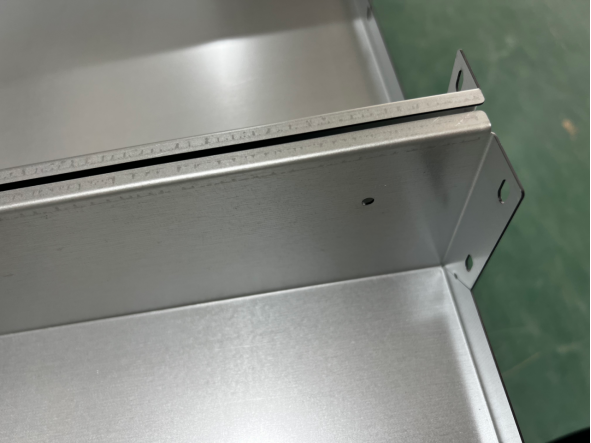
Formed metal corner and base mounting holes showing the reference surfaces and assembly interfaces.
From sheet metal to a finished component
A repeatable drawer cabinet program normally starts with the customer drawing and bill of materials. Engineering converts dimensions, bend directions, holes, fasteners and finish requirements into process information, then uses a first-article check to validate the assembly relationship. The formed edges and mounting ears visible in the photos show why design must account for both forming sequence and access for assembly.
During forming, panels may pass through blanking, punching or cutting, bending and edge finishing. Material condition, tooling clearance and springback can all influence final dimensions. A disciplined production line treats critical dimensions as inspection points and keeps the same reference system for first-article, patrol and final inspection. For a drawer cabinet, base flatness, side-panel squareness, front-to-rear parallelism and hole spacing may be more important to monitor continuously than a single cosmetic detail.
Assembly turns separate panels into a cabinet body. Operators need to verify the orientation of every mounting ear, hole-to-hole fit, fastener condition and available drawer clearance. In batch production, fixtures, gauges and clear work instructions reduce operator-to-operator variation. The rows of drawer cabinets in the ALRT factory photos also show an orderly flow for staging, counting, sampling, labeling and packing.
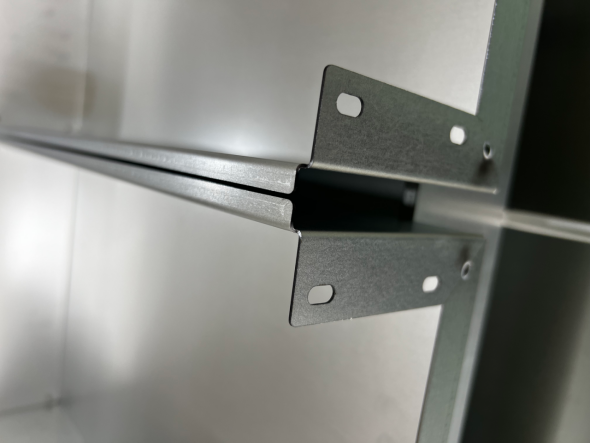
Mounting ears with repeated holes designed to connect the drawer cabinet to surrounding grill structures.
How batch production stays consistent
The third and fifth photos show the batch condition: finished or semi-finished cabinets are organized on pallets and in a defined handling area. The value of batch production is not simply volume. It is the ability to repeat the same dimensions, hole pattern and appearance requirements across many units. For buyers, that repeatability affects grill assembly, spare-part interchangeability and after-sales control.
To make consistency measurable, put acceptance criteria in the purchase order instead of relying on the phrase “produce to sample.” Define overall dimensional tolerances, critical hole tolerances, bend angles, edge condition, protective film or finish, opening feel and package marking. Material and finish requirements should name the grade, thickness, color or treatment, then be closed out with an approved sample, material document or mutually agreed inspection record. The photos in this article document the factory setting and product form; they do not replace a project-specific technical agreement.
Batch projects also need version control. If drawer width, hole position or front-panel style changes after approval, update the drawing, bill of materials, tooling and inspection sheet together, and state the effective lot. Separate parts by item number before release so different revisions are not mixed. First-article, sampling and packing records make later customer feedback much easier to isolate.
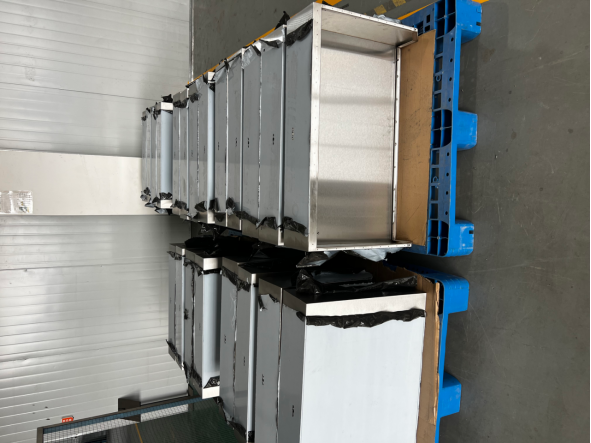
Batch of drawer cabinets arranged inside the ALRT grill factory for handling and shipment preparation.
Packaging and transport matter too
Metal drawer cabinets can be damaged during stacking, impact and exposure to moisture even when manufacturing is controlled. In the fifth photo, parts are grouped in layers for counting and movement. For shipment, the actual package should match the cabinet size and surface condition, with separators protecting bent edges and exposed faces from rubbing. Export projects should also confirm pallet dimensions, container loading, label content and spare-part ratios before release.
A useful package lets the receiving team check quantities quickly and understand the installation sequence after opening. Use the same part number on the outer package and inner component, and include an assembly drawing, fastener list and inspection record when required. This reduces time spent searching and helps the drawer cabinet move into final grill assembly with fewer interruptions.
If a protective film or temporary cover is used, the package instructions should explain when to remove it and how to clean the surface without scratching it. For ocean or long-distance road transport, photographs of pallet condition and quantity before loading can provide a useful handover record.
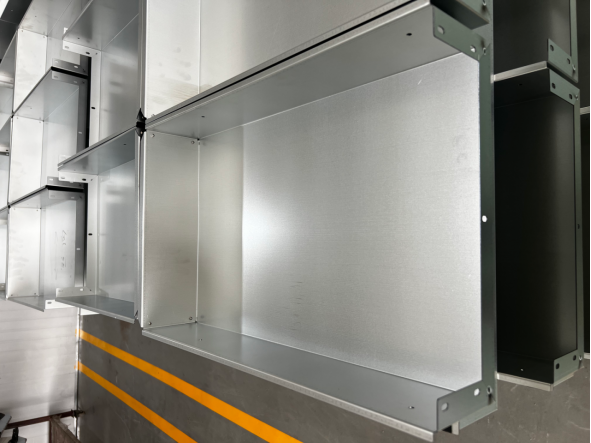
Flat base and side walls forming an easy-to-clean storage cavity inside a metal drawer cabinet.
A sourcing checklist for grill drawer cabinets
First, define the application. A residential outdoor kitchen may prioritize appearance, cleaning and low weight, while a commercial or project installation may prioritize repeated use, service access and batch delivery. Second, confirm dimensions and interfaces: cabinet opening, drawer count, usable depth, front height and mounting method. Third, define functional hardware: slide type, load rating, full or partial extension, stop, anti-drop feature and handle. Fourth, confirm material and finish on the drawing and approved sample. Fifth, agree on quality documents, sampling rate, package method and response time for nonconformities.
When comparing suppliers, ask each one to quote against the same technical questionnaire. That prevents an apparent low price from hiding different assumptions and quickly shows whether a supplier can collaborate on engineering. A long-term drawer cabinet partner should follow the project from drawing review and sample approval through batch delivery, with traceable records whenever dimensions or finishes change.
During sample review, place the cabinet in an actual or scale grill opening and check front gaps, interference with neighboring parts, tool access and the removal path. If a project includes multiple widths or heights, approve each representative size instead of using one fit check for every model.
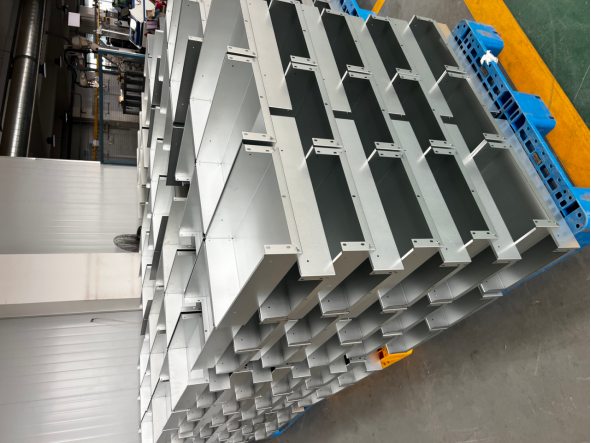
Drawer cabinet components organized in layers on pallets, showing batch manufacturing and material flow.
Conclusion
The ALRT factory photos point to three practical priorities in grill drawer cabinet manufacturing: a clear sheet-metal structure, repeatable connection and installation datums, and an orderly flow for batch handling. For brands, importers and outdoor-kitchen integrators, these priorities influence assembly stability, transport performance and the service life of the finished grill system. For a custom program, share the grill cabinet drawing, available installation space and target quantity first; then evaluate the sample and production plan together.
Frequently Asked Questions
Can a grill drawer cabinet be customized?
Yes. Confirm the cabinet opening, usable depth, drawer count and mounting method on a drawing, then approve a sample before production.
How should material and finish be confirmed?
Put the grade, thickness, color or surface treatment in the technical agreement, and close the requirement with an approved sample or inspection record.
What matters most when buying in batches?
Focus on dimensional and hole-pattern consistency, hardware specifications, protective packaging, quality records and nonconformity response, not unit price alone.